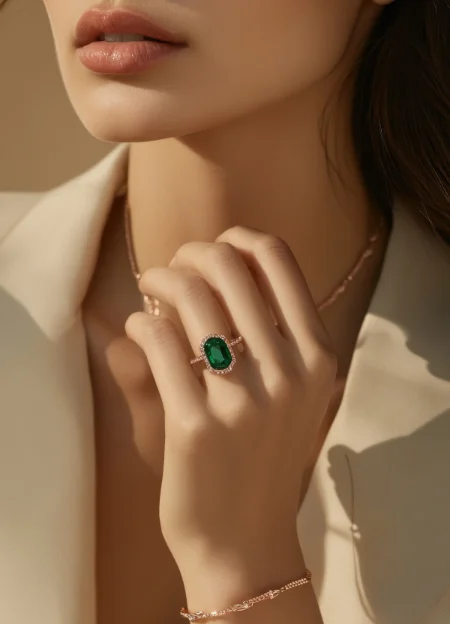
What is a diamond's cut?
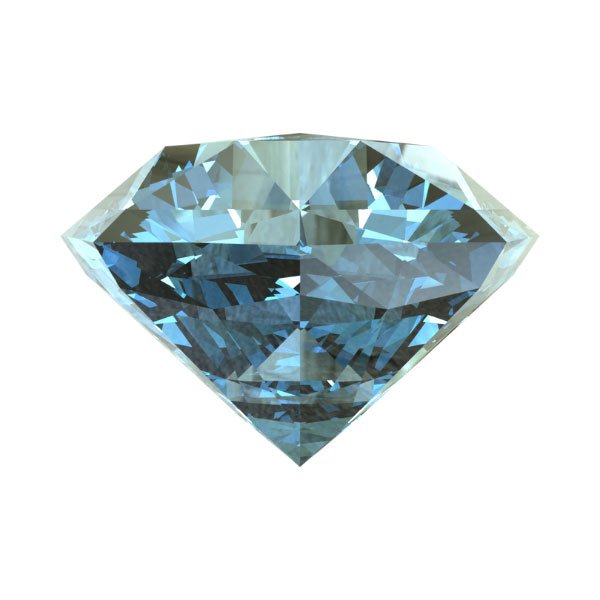
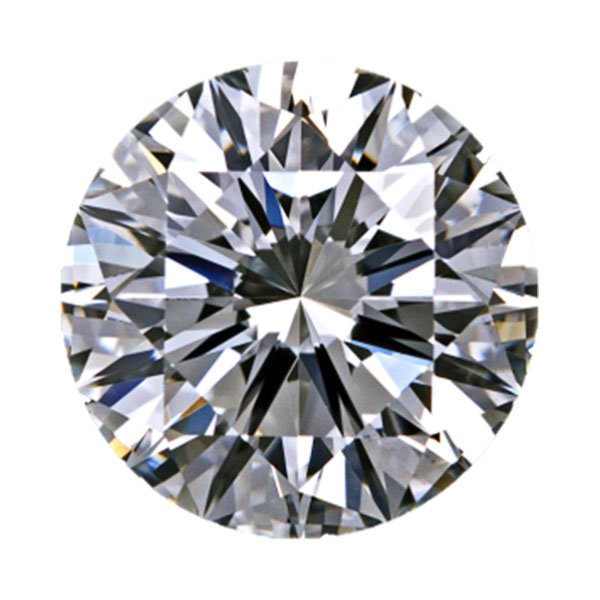
A diamond cut refers to how well the diamond has physically been cut to shape, not the shape of the diamond. Often it is the most important element of the 4Cs as it has the most effect on the diamond’s brilliance, sparkle, and overall beauty.
A poorly cut diamond can be too shallow or deep, either cut will limit the sparkle potential the diamond once had.
A well cut diamond can make a lower spec diamond more appealing than how it is on paper.
Why? Light performance. A diamond's best friend after a girl, is light. The way a diamond is cut determines its interaction with light, thus determining the sparkle potential a diamond has in the light, daylight, room light etc.
A diamond should be cut perfectly with aligned and symmetrical facets – a skill needing experience, hands on technical expertise and refined artistry.
Misaligned facets at the wrong angles cause light to leak, causing light to reflect out of the pavilion or culet instead of the table and crown (diamond top). This leads to a lifeless stone with a dark centre.
Diamond Cuts are graded from Poor to Excellent. Excellent to Very Good cut diamond is the ideal range to have your diamond as it allows a very good light flow and reflection from your diamond, resulting in you having the best sparkle possible, that’s what you want in a diamond. A diamond cut grade chart can help you see how different cuts compare.

How light works inside a diamond, key factors:
Diamond cuts and reflections influence how a diamond sparkles visually to the eye, regardless of other specs like colour, clarity etc. So here’s what happens when light hits a diamond
Reflection: Some light bounces right off the top of the diamond through the table facet. The rest of the light enters deeper into the diamond and reflects off the internal walls. As light exits the diamond, it splits into different colors, which creates the rainbow effect you often see.
Brilliance: Is how bright a diamond is, it's created by a fusion of all white light reflections from the surface and the inside of a polished diamond The diamond table (top) takes in white light, this splits up into the full spectrum of colours. This bounces back and reflects within the diamond before projecting upwards and out via the table, leaving as white light.
Fire/Dispersion: The splitting of light into the colours of the visible spectrum, seen as flashes of rainbow colours. White light enters and exits through the diamond table, flashes of colours appear when light glistens out from the centre of the stone and through the crown.
Scintillation: The flashes of light and dark, or sparkle. When a diamond or light source moves, light 'dances' off the facets. When a diamond is cut nicely, light flows from all angles.
Excellent to Very Good cut grade diamonds (GIA grading system) reflects light out through the table and crown, making eye-catching flashes of white and coloured light, the polish and dimensions of the stone creates brilliance, fire and scintillation that synchronise together, creating a beautiful sparkle.
What is a Diamond’s Depth?
A diamond's depth impacts its ability to reflect light and plays a key role in the quality of the diamond cut. Depth is measured from the table (top) to the culet (bottom). To calculate the depth as a percentage, divide the diamond depth by its diameter (total width) x 100. E.g 7mm depth ÷ 10mm width x 100 = 70%.
Below are helpful diamond diagrams which illustrates how a diamonds depth affects how light behaves within that diamond.
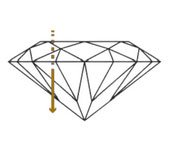
Shallow-Cut Diamonds
The light enters and quickly exits from the sides, limiting the sparkles.
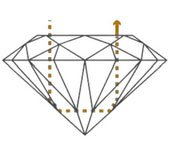
Ideal-Cut Diamonds
These diamonds have the best angles and facets, allowing the light to enter and flow through, illuminating the whole diamond.
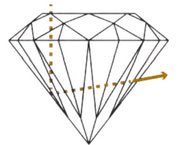
Deep-Cut Diamonds
TheseLight flows and exits awkwardly through the diamond, ultimately reducing sparkle
Shallow Cut Diamond Drawbacks:
Seems Dull & Lifeless: Shallow diamonds can look dull and lifeless as a result of light loss.
Limited Brilliance and Sparkle: Shallow cut diamonds suffer with light leakages, thus unable to reflect light effectively, leading to less brilliance and sparkle compared to ideal cuts. Light enters the stone at a low angle, often travelling through it rather than reflecting back towards the eye.
Poor Performance in Low Light: The lack of light reflection makes them appear less attractive in dim or normal lighting.
Lower Value: Generally diamonds are not an investment, shallow cut diamonds are likely to drop more in value over time compared to ideal cut diamonds. The plus side is that it’ll cost you less to start with.
Deep Cut Diamond Drawbacks:
Visibly Smaller Look: The deeper the cut, the less surface area on the top, making the diamond appear smaller than a similarly weighted diamond with a less deep cut. E.g By weight the diamond can be 1ct, but look like 0.7ct.
Limited Brilliance and Fire: Deep cuts allow light to escape through the bottom, this light loss limits sparkle and visual appeal of the diamond.
Chipping Risk: Deep cuts can sometimes create sharper corners or edges, increasing the risk of chipping.
Magnified Inclusions:
Deep cuts can magnify the visibility and appearance of some inclusions, this may detract from the overall beauty.
Ideal Depth Percentages by Diamond Shape:
| - Round: 59 - 62.6% | - Pear: 58 - 62% | - Asscher: 61 - 67% |
| - Oval: 58 - 62% | - Princess: 64 - 75% | |
| - Radiant: 61 - 67% | - Cushion: 61 - 67% | |
| - Emerald: 61 - 67% | - Marquise: 58 - 62% |
Polish of a Diamond
Once a diamond is cut, each facet is polished to allow the highest brilliance.
Polish describes how smooth the diamond's surface is.
High quality polishing gives you a diamond with more brilliance.
Poorly polished diamonds lead to poorer/altered light reflection as there’ll be obvious blemishes or scuffs.
Symmetry of a Diamond
Symmetry refers to how perfectly the facets align.
Diamonds with excellent symmetry will have the best constant sparkle, as the facets are aligned well, allowing white light to reflect evenly.
In contrast, poor symmetry (uneven facets) in a diamond leads to limited sparkle and less brilliance.
Polish describes how smooth the diamond's surface is.
High quality polishing gives you a diamond with more brilliance.
Poorly polished diamonds lead to poorer/altered light reflection as there’ll be obvious blemishes or scuffs.
Diamond Components
Alongside diamond facets and depth, there are five areas of a diamond that affect its overall brilliance. They are; table, crown, girdle, pavillion, and culet. Below is a breakdown of each area and an explanation of its intended purpose.
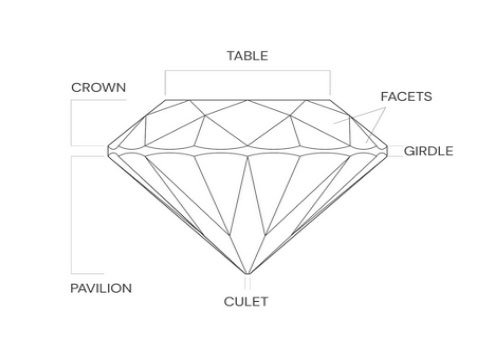
Table & Table Percentage
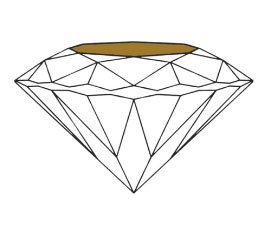
Table is the biggest facet of a diamond, making the flat surface at the diamond's top.
The table percentage is a measurement of the table width in relation to the diamond width. Having an optimal table percentage largely contributes to how much fire and brilliance the diamond has.
Crown
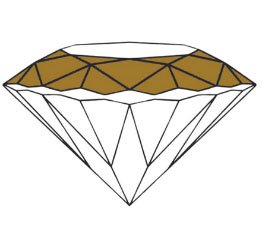
The crown is the top angled section of a diamond, between the table and girdle.
The crown has a significant role in light dispersion, which adds to the diamond’s brilliance and fire.
A well-cut crown enables more light to flow through the diamond, increasing its shimmer. Whether the crown facets are brilliant cut or step cut will impact how the diamond works with light. Most diamonds are brilliant cut facets (the more sparkly one).
Girdle
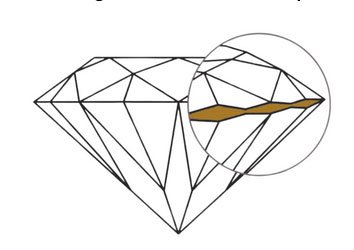
The girdle is the widest point of the diamond, it’s the outer vertical edge situated between the crown and pavillion. Most diamonds tend to have a faceted girdle, while some are fully level and polished and some rough. Visually there isn’t a massive difference, unless you look at it magnified, in this case a faceted girdle is more desirable, and doesn’t add to the diamonds cost.
Thick girdles are less pleasing aesthetically, thin girdles have higher chances of chipping.
Pavillion
This is the bottom of the diamond, starting from beneath the girdle. Its designed to reflect incoming light upwards through the top of the diamond, this adds to the diamonds brilliance massively.
Having this important role means the depth the pavillion is cut to is imperative.
Why?
When the pavillion is cut optimally, any light that enters is balanced and reflected well, utilising and maximising all available light, adding to the sparkle.
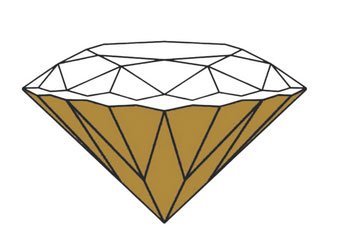
If the depth of the pavillion is too shallow or too deep, any light entering from above will mostly not be reflected back up, the sparkle is lost. It instead escapes subtly through the sides or bottom.
This is the pointed bottom of the diamond, it’s the smallest facet of a diamond. They’re designed to protect the pavilion from any damages, typically in today's jewellery settings the diamond is entirely protected by the metal rather than the culet or other elements.
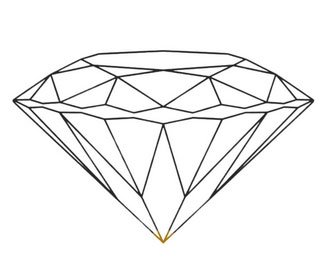
Most new diamonds often lack a culet as it’s not particularly needed, diamond certifiers will grade this as ‘None’ in their reports. If there is any culet, it’ll be hardly visible. Little to no culet is more desirable as it helps the diamond have a clean look.
Pricing and More
Excellent cut graded diamonds usually drive the price upwards as it boasts higher brilliance and light performance.
A beautifully cut diamond with lower colour and clarity can outperform a diamond with higher colour and clarity but lower cut grade. And the cost of which will either be higher or very close to the higher colour/clarity diamond.
Alongside cut grading, other 4C’s factors do remain in influencing a diamond's price, as well as factors like tinges, shades, hues, milky or cloudiness, these subtle variations are caused by trace elements present within the diamond’s crystal structure during its growth and formation underground. These elements such as boron, nitrogen etc absorb certain light wavelengths, causing the diamond to appear with a dash of brown, blue, yellow, green, dark shades and other colours.
Round cut diamonds often cost more than others as it typically has the best symmetry, the most sparkle, more diamond waste whilst cutting and higher demand.
Some diamonds may have less demand but still be costly as there’s a lot of diamond wastage occurring when cutting the diamond to shape e.g baguette.
Fun fact, oval cut diamonds waste less raw diamond than round cut diamonds during the cutting process.
Other diamonds shapes can cost a pretty penny too, in some cases more than round cuts, this is when the factors add up, for instance, high colour & clarity grades, no fluorescence, cut to top notch standards, eye clean etc. These diamond cuts include but are not limited to; oval, cushion, emerald and more.
Read about Colour, Clarity , and Carat.
Want to know more?
If you want more clarification or have any questions, contact us via Instagram @aylahfinejewellery, call us on 0203 196 1630, WhatsApp us on 07785 924722, email us on info@aylahfinejewellery.com. We’ll help you!
Receive our latest offers, news and promotions straight to your inbox. Just enter your email address to join our world of diamonds!